Studio
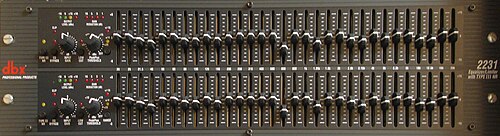
dbx 231s Dual 31-Band Graphic Equaliser
★★★★★ 4.7
✅ In stock — 5 available
The dbx 231s is a dual-channel 31-band graphic equaliser, and it solves a problem that no amount of speaker upgrading will fix: the room. Every hall has resonances, and in Kenya most performance spaces are concrete, glass and tile, which are the three worst surfaces for controlled sound. This is the tool that tames them. WHAT A THIRD-OCTAVE EQUALISER IS FOR Thirty-one bands per channel means each fader controls a third of an octave. That resolution is fine enough to pull down a single problem frequency without disturbing the material either side of it. A typical church hall has a boom somewhere between 125 Hz and 250 Hz caused by the room dimensions, and a harsh ring around 2 kHz to 4 kHz from hard walls. On a mixer's three-band equaliser you cannot address those without gutting the whole midrange. On a 31-band you find the exact fader, pull it down two or three decibels, and the problem is gone while everything else stays intact. The second and equally important job is feedback control. Feedback occurs at the frequency where the loop gain between microphone and speaker first exceeds unity, and it is almost always a room resonance. Notch that band and you can run the system several decibels louder before it rings. For churches with radio microphones and a preacher who walks in front of the speakers, that headroom is the whole difference between usable and unusable. KEY SPECIFICATIONS Configuration: dual-channel 31-band graphic equaliser, third-octave spacing Format: 19-inch rackmount, 2U Filter range: 20 Hz to 20 kHz Boost and cut range: switchable between plus or minus 6 dB and plus or minus 12 dB Low-cut filter: 40 Hz switchable high-pass per channel Input and output: balanced XLR and TRS on both channels Type III noise reduction: dbx proprietary noise reduction on the outputs Bypass: hard-wire relay bypass per channel Metering: input and output LED metering Gain control: input gain trim per channel Construction: steel chassis, rackmount ears fitted WHY THE SWITCHABLE RANGE MATTERS The plus or minus 6 dB setting doubles the physical resolution of every fader. Once you have found your problem frequencies, switching to the narrower range means each millimetre of fader travel makes a smaller change, so you can dial the correction in precisely rather than overshooting. Experienced engineers set up in 12 dB mode and then work in 6 dB mode. It is a small feature that makes the unit far more usable than a cheaper equaliser with a single fixed range. THE 40 HZ LOW CUT EARNS ITS PLACE Almost nothing useful in speech or most live music lives below 40 Hz, but plenty of destructive energy does: stage rumble, handling noise, air conditioning, foot traffic on a wooden platform. Engaging the low cut removes that energy before it reaches your amplifiers, which recovers headroom and stops your woofers wasting excursion on sound nobody can hear. WHO THIS IS FOR Churches and halls with persistent feedback or a boomy room. Sound hire companies who work in different venues every week and need to tune quickly on arrival. Schools and conference centres with fixed installed systems. Anyone running a system that sounds good in one room and terrible in another. It is equally at home inserted across the main outputs of a live system or used on monitor sends, where ringing is usually worse because the wedges point straight at the microphones. HOW TO USE IT WELL Cut, do not boost. Almost all useful graphic equalisation is subtractive. Boosting a frequency adds energy your amplifiers have to produce and usually makes feedback worse. If something sounds dull, cut elsewhere rather than boosting the top. Ring the room out before the audience arrives. Bring the system up slowly until it just begins to ring, identify the frequency, cut it a few decibels, and repeat. Three or four notches usually buys a great deal of gain before feedback. Remember the room changes when it fills. A hall full of people absorbs high frequencies, so a system tuned in an empty room will sound duller once the congregation arrives. Leave a little brightness in hand. WARRANTY, DELIVERY AND ADVICE Genuine dbx stock with a 12-month warranty, delivered anywhere in Kenya and paid on delivery by M-Pesa or cash. If your system already sounds wrong and you are not sure whether the fix is an equaliser, better speaker placement, or a different microphone, call us and describe the symptoms. Quite often the cheapest solution is moving a speaker two metres.
Read full description ↓Prefer to order by phone?
Talk to a real person — we'll help you pick the right gear.
- 🚚 Countrywide delivery (flat KSh 350, KSh 200 within Nairobi)
- 💳 Pay via M-Pesa on delivery — no upfront payment needed
- 🛡️ Genuine products with warranty
About this studio
The dbx 231s is a dual-channel 31-band graphic equaliser, and it solves a problem that no amount of speaker upgrading will fix: the room. Every hall has resonances, and in Kenya most performance spaces are concrete, glass and tile, which are the three worst surfaces for controlled sound. This is the tool that tames them.
WHAT A THIRD-OCTAVE EQUALISER IS FOR
Thirty-one bands per channel means each fader controls a third of an octave. That resolution is fine enough to pull down a single problem frequency without disturbing the material either side of it. A typical church hall has a boom somewhere between 125 Hz and 250 Hz caused by the room dimensions, and a harsh ring around 2 kHz to 4 kHz from hard walls. On a mixer's three-band equaliser you cannot address those without gutting the whole midrange. On a 31-band you find the exact fader, pull it down two or three decibels, and the problem is gone while everything else stays intact.
The second and equally important job is feedback control. Feedback occurs at the frequency where the loop gain between microphone and speaker first exceeds unity, and it is almost always a room resonance. Notch that band and you can run the system several decibels louder before it rings. For churches with radio microphones and a preacher who walks in front of the speakers, that headroom is the whole difference between usable and unusable.
KEY SPECIFICATIONS
Configuration: dual-channel 31-band graphic equaliser, third-octave spacing Format: 19-inch rackmount, 2U Filter range: 20 Hz to 20 kHz Boost and cut range: switchable between plus or minus 6 dB and plus or minus 12 dB Low-cut filter: 40 Hz switchable high-pass per channel Input and output: balanced XLR and TRS on both channels Type III noise reduction: dbx proprietary noise reduction on the outputs Bypass: hard-wire relay bypass per channel Metering: input and output LED metering Gain control: input gain trim per channel Construction: steel chassis, rackmount ears fitted
WHY THE SWITCHABLE RANGE MATTERS
The plus or minus 6 dB setting doubles the physical resolution of every fader. Once you have found your problem frequencies, switching to the narrower range means each millimetre of fader travel makes a smaller change, so you can dial the correction in precisely rather than overshooting. Experienced engineers set up in 12 dB mode and then work in 6 dB mode. It is a small feature that makes the unit far more usable than a cheaper equaliser with a single fixed range.
THE 40 HZ LOW CUT EARNS ITS PLACE
Almost nothing useful in speech or most live music lives below 40 Hz, but plenty of destructive energy does: stage rumble, handling noise, air conditioning, foot traffic on a wooden platform. Engaging the low cut removes that energy before it reaches your amplifiers, which recovers headroom and stops your woofers wasting excursion on sound nobody can hear.
WHO THIS IS FOR
Churches and halls with persistent feedback or a boomy room. Sound hire companies who work in different venues every week and need to tune quickly on arrival. Schools and conference centres with fixed installed systems. Anyone running a system that sounds good in one room and terrible in another.
It is equally at home inserted across the main outputs of a live system or used on monitor sends, where ringing is usually worse because the wedges point straight at the microphones.
HOW TO USE IT WELL
Cut, do not boost. Almost all useful graphic equalisation is subtractive. Boosting a frequency adds energy your amplifiers have to produce and usually makes feedback worse. If something sounds dull, cut elsewhere rather than boosting the top.
Ring the room out before the audience arrives. Bring the system up slowly until it just begins to ring, identify the frequency, cut it a few decibels, and repeat. Three or four notches usually buys a great deal of gain before feedback.
Remember the room changes when it fills. A hall full of people absorbs high frequencies, so a system tuned in an empty room will sound duller once the congregation arrives. Leave a little brightness in hand.
WARRANTY, DELIVERY AND ADVICE
Genuine dbx stock with a 12-month warranty, delivered anywhere in Kenya and paid on delivery by M-Pesa or cash. If your system already sounds wrong and you are not sure whether the fix is an equaliser, better speaker placement, or a different microphone, call us and describe the symptoms. Quite often the cheapest solution is moving a speaker two metres.
- Brand
- dbx
- Category
- Studio
- Availability
- 5 in stock
- Rating
- 4.7 / 5
Customer reviews
No reviews yet — be the first to share your experience.
Log in to leave a review — it takes 20 seconds.